Gallery 6: Senjafuda (Votive Slips)

Takahashi Tounosuke (1876-1961)
Taira no Koremochi on Maple Viewing Trip Being Attacked by a Demon.
19.2 x 14.4 cm
Senjafuda translates to “thousand shrine tags.” Their original purpose was as votive slips that visitors affixed to shrine and temple gates and buildings. Initially, senjafuda were simple designs limited to the name of the worshipper. However, as visits to multiple shrines became popular, senjafuda came to depict more complex imagery. Senjafuda clubs were also established to admire, exchange, and collect these miniature prints. The senjafuda in this collection depict shrine visits, kabuki actors, bunraku theater, deities and a few other topics. Images here are depicted without margins. Clicking on an image will reveal the entire senjafuda with margins..
The prints in this section were produced for the Tokyo Senjafuda Association. The carver is identified as Choken who may have also been the artist. All were created in the 1930s.

20.7 x 15.3 cm

Ichikawa Danjuro IX as Teruhi no Miko in the play Uwanari, Adapted from a print by Torii Kiyosada from the series The Kabuki Eighteen (Kabuki Juhachiban). 4.8 x 14.5 cm

Ichikawa Danjūrō IX in His Prime. 9.6 x 14.4 cm

4.8 x 14.4 cm

Mount Yudono in Dewa Provence. 9.7 x 14.4 cm

4.8 x 14.4 cm
The Senjafuda in this section are from a set of depicting the Saigoku Kannon Pilgrimage and were produced for the Tokyo Senjafuda Association. The carver is identified as Choken who may have also been the artist. They are from the early Showa era.

Unidentified Artist
Number 8 Yamato Chokokuji. 4.8 x 14.4 cm

Unidentified Artist
Number 31 Chomeiji. 4.4 x 17.4 cm

Unidentified Artist
Number 45 Iyo Iwayaji. 4.8 x 14.5 cm
These prints are from a set depicting Arhats. The set appears to be missing 5 prints since one of the prints is not an Arhat and 16 would have been expected to have been included. In four cases, the artist chose to extend the image into the margins, an approach occasionally encountered in other Japanese prints, The presentations below adhere to the site’s convention of not showing margins. Higher resolution prints with margins can be viewed by clicking on the image. The artist has not been identified.
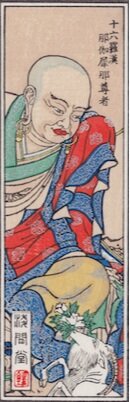
Nagasaina sonja. 4.6 x 14.2 cm

Jubaka sonja. 4.7 x 14.3 cm

Hantaka sonja. 4.9 x 14.2 cm

Bindorabaradaja sonja. 4.7 x 14.5 cm

Banabashi sonja. 4.8 x 14.3 cm

Kanakabassa sonja. 4.7 x 14.3 cm

Ragora sonja. 4.6 x 14.3 cm

Nakora sonja. 4.6 x 14.3 cm

Chudahantaka sonja. 4.8 x 14.3 cm

Ajita sonja. 4.8 x 14.3 cm

Ingada sonja. 4.7 x 14.3 cm

Completing the Set: Suiten. 4.7 x 14.3 cm
This set of eighteen senjafida depict floats used in festival parades. The artist and publishing date have yet to be determined.

4.8 x 14.5 cm

4.8 x 14.5 cm

4.8 x 14.3 cm

4.7 x 14.3 cm

4.7 x 14.4 cm

4.8 x 14.3 cm

4.8 x 14.3 cm

4.8 x 14.4 cm

4.7 x 14.3 cm

4.8 x 14.4 cm

4.8 x 14.4 cm

4.8 x 14.4 cm

4.8 x 14.3 cm

4.8 x 14.4 cm

4.7 x 14.3 cm

4.8 x 14.4 cm

4.8 x 14.3 cm

4.8 x 14.3 cm
This set of 18 senjafuda depicts Mount Fuji from views along the Tokaido road. The scenes do not appear to correspond to any of the famous Tokaido Road series by Hiroshige. The set is undated. The artist is currently unidentified.

4.8 x 14.3 cm

4.8 x 14.3 cm

4.8 x 14.3 cm

4.8 x 14.3 cm

4.8 x 14.3 cm

4.8 x 14.3 cm
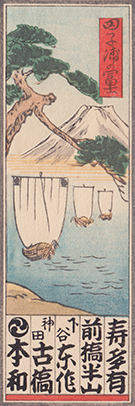
4.8 x 14.3 cm

4.7 x 14.3 cm

4.8 x 14.3 cm

4.9 x 14.3 cm

4.8 x 14.3 cm

4.8 x 14.3 cm
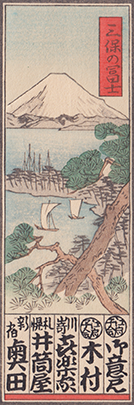
4.7 x 14.3 cm

4.8 x 14.3 cm

4.7 x 14.3 cm

4.8 x 14.3 cm

4.8 x 14.3 cm

4.8 x 14.3 cm
The following Senjafuda are from the series Tokiwazu Awase Mokuroku. The kabuki portraits were designed by the artist Yoshida Eisho (aka Yoshida Unosuke) and feature actors in specific roles and plays. Additional prints by the artist can be seen in Gallery 3P.

Ichikawa Sadanji II as Inagawa in an unidentified play. Undated. 9.5 x 14.2 cm

Ichimura Uzaemon XV as Fukuoka Mitsugi in the play Ise Ondo Koi no Netaba. Undated. 9.5 x 14.2 cm

Kataoka Nizaemon XI as Heisaku in Numazu, Act VI of the play Igagoe Dochu Sugoroku. Undated. 9.6 x 14.1 cm

Matsumoto Koshiro VII as Omori Hikoshichi in the play Omori Hikoshichi. Undated. 9.6 x 14.2 cm

Nakamura Kichiemon I as Mitsukuni in the play Mito Komon-ki. Possibly 1918. 9.6 x 14.2 cm

Nakamura Ganjiro I as Fujiya Izaemon in the play Kuruwa Bunsho. Undated. 9.6 x 14.1 cm

Matsumoto Koshiro VII as Sekibe in the play Tsumoru Koi Yuki no Seki no To. Undated. 9.6 x 14.2 cm

Ichimura Uzaemon XV as Fukuoka Mitsugi in the play Ise Ondo Koi no Netaba. Undated. 9.5 x 14.2 cm

Nakamura Utaemon V as Tokiwa Gozen in the play Tokiwa Gozen. Possibly 1923. 9.6 x 14.1 cm

Onoe Baiko VI as Onatsu Kyoran in the play Onatsu Kyoran. Undated. 9.5 x 14.2 cm

Onoe Kikugoro VI as Tsujin in the play Noriaibune. Undated. 9.6 x 14.2 cm

Onoe Kikugoro VI as Kamuro in the play Modori Kago. Undated. 9.5 x 14.2 cm
The four senjafuda in this section are part of a set by an unidentified artist that depicts either the first 9 actors named Ichikawa Danjuro or the Eighteen Best Plays of the Ichikawa school
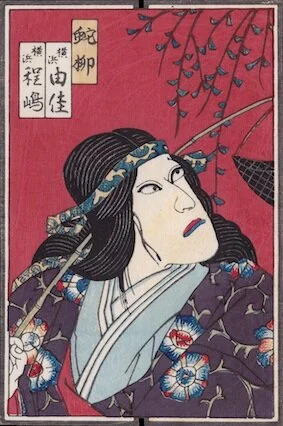
Actor as Jayanagi. 10.0 x 15.0 cm

Ichikawa Ebizo V (top/left) and Ichikawa Danjuro VIII in Zohiki. Adapted from an 1852 print by Utagawa Toyokuni III. 10.0 x 15.2 cm

Actor as Kagekiyo. 10.0 x 15.1 cm

Ichikawa Danjuro IX in Uiro Uri. 10.1 x 15.1 cm
These eleven senjafuda appear to be from a set of various Ichikawa actors and aragoto roles. The artist has not been identified.

9.8 x 14.3 cm

Ichikawa Dannosuke. 9.9 x 14.3 cm

Actor as Umeomaru in The Struggle for the Carriage scene from The Secrets of Sugawara's Calligraphy. 9.9 x 14.3 cm

9.8 x 14.3 cm

Actor as Watonai in The Battles of Coxinga. 9.8 x 14.2 cm

Actor as Kagekiyo. 9.9 x 14.3 cm
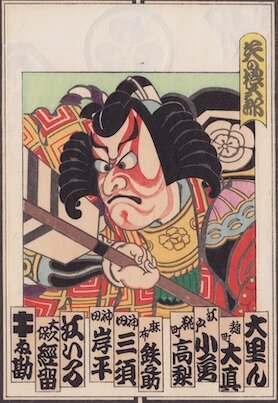
Actor as Yanone Goro in the play Yanone. 9.8 x 14.2 cm

9.9 x 14.3 cm
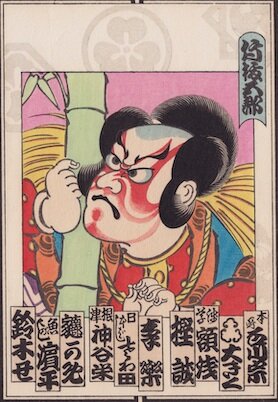
Actor as Soga Takenuki Goro in the play Oshimodoshi. 9.8 x 14.2 cm

9.8 x 14.3 cm

9.8 x 14.4 cm
This set of 25 senjafuda depicts kabuki actors portrayed on hagoita. Actor names and roles are yet to be determined. In this series, the hagoita are drawn to extend outside the usual boundaries and into the margins of the senjafuda, a dramatic embellishment that is also occasionally also found in larger prints. The convention of this website is to present images without margins. Higher resolution prints with margins can be viewed by clicking on the image. The single panel images are approximately 5.1 x 14.4 cm. The three images that are two panels in width are approximately 9.6 x 14.3 cm.


Insert for the senjafuda series All About Kites. Published for a collecting group in 1928. Artist(s) yet to be identified.

9.6 x 14.3 cm

9.6 x 14.3 cm

Kintaro Fighting a Demon. 9.7 x 14.4 cm

Kintaro Fighting a Demon. Second copy. 9.6 x 14.3 cm

9.6 x 14.4 cm

9.5 x 14.3 cm

9.6 x 14.3 cm

9.5 x 14.4 cm

9.7 x 14.3 cm

Daruma, 9.6 x 14.3 cm

9.7 x 14.5 cm

9.6 x 14.3 cm

9.5 x 14.2 cm

9.6 x 14.4 cm

9.5 x 14.4 cm

9.6 x 14.4 cm
Another set of kite theme senjafuda likely dating from the 1920-1930s. Note the similarity to some of the images above and the rabbit and waves image found later in this gallery. These eight images had been cropped and pasted into a collector’s book.

9.5 x 13.9 cm

9.6 x 14.1 cm

9.5 x 14.0 cm

9.6 x 14.2 cm

9.6 x 14.2 cm

9.7 x 14.0 cm

9.7 x 14.2 cm

9.5 x 13.9 cm
After Tsukioka Yoshitoshi (Taiso Yoshitoshi) (1839-1892). Miniaturization and modifications of prints by the artist that were reproduced as senjafuda.

Hodemi-no Mikoto Riding a Sea Bream. From the series Biyu suikoden (Handsome and Brave Heroes of the Suikoden). Undated. 9.5 x 14.1 cm

Looking as if She is Enjoying Herself: the Appearance of a Teacher during the Kaei Period. From the 1888 series Thirty-Two Aspects of Customs and Manners (Fuzoku Sanjuniso). Undated. 9.3 x 13.6 cm
This set of senjafuda devoted to images of fishing was produced in 1927 for the Toto Votive Tablet Association. The artist has yet to be identified.

Fishing Series Descriptive Sheet. 19.2 x 14.4 cm

9.6 x 14.4 cm

9.7 x 14.4 cm

9.5 x 14.3 cm

9.6 x 14.3 cm

9.6 x 14.4 cm

9.6 x 14.3 cm

9.6 x 14.4 cm

9.6 x 14.5 cm

9.6 x 14.4 cm

9.6 x 14.4 cm

9.6 x 14.4 cm

9.6 x 14.4 cm

9.6 x 14.4 cm

9.6 x 14.4 cm

9.6 x 14.4 cm

9.6 x 14.4 cm

9.6 x 14.4 cm
This group of senjafuda by an unidentified artist are from the series Twelve Training Zodiac Signs and was created for a senjafuda colleting club, the Toto Nobi Association located in Chiyoda City. The date of the set has not been determined but appears to be related to the year of the rabbit. The image for monkey had a hole near the lower central margin that has been digitally “repaired” for presentation here..

Rat. 19.2 x 14.5 cm

Ox. 9.6 x 14.5 cm

Tiger. 9.6 x 14.5 cm

Rabbit. 19.2 x 14.4 cm

Dragon. 9.6 x 14.5 cm

Snake. 9.6 x 14.5 cm

Horse. 9.6 x 14.5 cm

Monkey. 19.2 x 14.5 cm

Goat. 9.7 x 14.5 cm

Rooster. 9.6 x 14.4 cm

Dog. 9.6 x 14.4 cm

Boar. 19.2 x 14.5 cm
These two senjafuda were acquired with the set of fishing images immediately above. One is clearly dated 1927, the same year as the fishing set. However, the slight variation in size in the first and lack of any reference to fishing in both suggest that they are not associated with that series but are likely associated with the same collecting club.

Unidentified Artist
1927. 10.0 x 14.3 cm

Unidentified Artist
9.6 x 14.4 cm
This set of pochibukuro features rituals related to the imperial court, particularly the enthronement of the emperor. These likely were printed for the 1928 enthronement of Hirohito but have not been clearly dated. Many of the image designs are similar to woodblock printed postcards published to commemorate that event. The artist has not been identified.

Imperial Palace, Kyoto. 19.2 x 14.4 cm

Yukisai (Yuki Hall Cerimony). 9.6 x 14.4 cm

Gosechi no mai dance at the Daijo-sai festival celebrating the succession of the emperor. 9.6 x 14.4 cm

Taihei Raku Dance. 9.6 x 14.4 cm

Manzai Raku Dance. 9.6 x 14.5 cm

Lord Kiden Togyo. 9.6 x 14.4 cm

Prestige Oriented. 9.7 x 14.5 cm

Bearer of Dignity. 9.6 x 14.4 cm

Tsukasa Tuskasa. 9.6 x 14.4 cm

Daijosai. 9.6 x 14.5 cm

Daijosai Procession. 9.6 x 14.4 cm

Ascension to the Throne. 9.6 x 14.5 cm

Imperial Visit to the Jingu Shrine. 9.6 x 14.5 cm
This set of senjafuda depicts Ema (picture horses). These wooden plaques are left as offerings by visitors of Shinto and Buddhist shrines. The reference to horses related to the original tradition of wealthy patrons donating horses. The tradition was later changed to the donation of symbolic plaques with horse paintings. Eventually, the depiction of horses was replaced by a variety of other subjects. This set was created for the Mutsumi Association for Gathering/Offering Slips in 1945. The artist of these senjafuda remains unidentified, although at least one work lists the artist as Takahashi who may be Takahashi Tounosuke (1876–1961). The set came with two promotional senjafuda for club meetings, one of which was dated 1953. Additional senjafuda with names may be associated with the set or simply reflect members of the group that were collected over time.

The image on this four panel senjafuda was adapted from the design on a surimono by Shibata Zeshin (1807-1889). 22.8 x 15.9 cm
These senjafuda likely feature the names of individuals in the collecting group.

Tachibana Unosuke
5.0 x 14.4 cm

Matsuni from the Matsuya Shop in Kudan, Tokyo. 5.0 x 14.3 cm

Yamacho, Yabu in Kanda. 5.1 x 14.4 cm

Yamacho, Yabu in Kanda. Second copy. 5.1 x 14.4 cm

Chikabo
5.0 x 14.3 cm

Takasaki Yoshida. 2.8 x 7.7 cm

Tabume of Komaga-ta. 2.7 x 9.2 cm
Two event announcements that came with the set. The fact that one is dated 1953 suggests that these were not related to the set but were additional items collected by the original collecting group member.

An announcement of a Regular Meeting of a senjafuda club for December 25th at 1:00 PM at the Otama Shinmei Shrine Office to discuss themes and exchange topics. Sponsored by Tono and Matsuya of Asakusa. 10.8 x 15.1 cm

Announcement to the members of the regular attendance group of a senjafuda competition for March, 1953 at the Matsuya Hotel. 10.9 x 15.0 cm
The Ema related senjafuda set.

Ushi Tenjin. 10.9 x 15.1 cm

Tako Yakushi (the Octopus Healer/Buddha of Medicine). 10.8 x 15.0 cm

Sanbo-Kojin (the Japanese hearth deity). 10.8 x 15.0 cm

Sacred Shrine Horse. 10.8 x 15.0 cm

White Falcon. 10.8 x 15.0 cm

Suitengu Shrine. 11.0 x 15.1 cm

Tanuki Dance. 10.7 x 15.0 cm

Takahashi Tounosuke? (1876–1961)
Karasu-Tengu and O-Tengu masks. 10.8 x 15.0 cm

Myoken. 10.8 x 15.0 cm

“Safe Voyage at Sea”. 10.8 x 15.0 cm

“May the Theaters be Filled to Capacity”. 10.8 x 15.0 cm

Ushijima Shrine. 10.8 x 15.0 cm

Fire Brigade Association. 10.8 x 15.0 cm

The Fan Society. 10.8 x 15.0 cm

“Everlasting Good Fortune in Battle”/ Asama Shrine. 10.8 x 15.0 cm

Vow of Abstinence from Alcohol. 10.9 x 15.0 cm

Prayer for Breast Milk by a 30 Year Old Woman/Mt. Inari. 10.8 x 15.0 cm
The following senjafuda are all associated with images of rats and were presumably created to celebrate the year of the rat. The artists have yet to be identified. Two images that originally came from this group bare the seal or signature of Hasegawa Sadanobu III and can be found in this gallery with other works by the artist.

Unidentified Artist. Uncut triptych depicting mice bathing. 19.4 x 15.7 cm

5.6 x 14.1 cm

4.9 x 13.9 cm

4.8 x 14.2 cm

5.0 x 15.5 cm

4.7 x 14.1 cm

4.8 x 14.1 cm

4.7 x 14.1 cm

4.7 x 14.1 cm

4.8 x 14.1 cm

4.7 x 14.2 cm

4.7 x 14.1 cm
This Section Under Construction

Dawn Snow at Nihonbashi. 23.0 x 15.2 cm
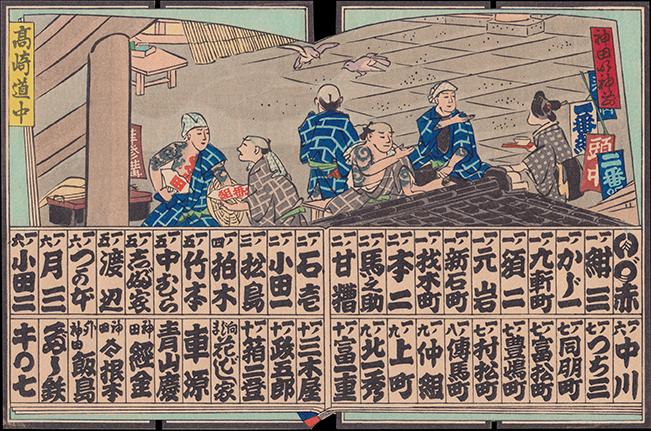
Within the Precincts of Kanda Myojin Shrine. 23.0 x 15.2 cm

Kuragano Station and Shinmachi Station. 23.0 x 15.2 cm

Hikawa Shrine in Omiya and Urawa Station. 23.0 x 15.2 cm

The Open Fields of Okegawa and Kamo Grand Shrine. 23.0 x 15.2 cm

Eight Views of Kumagaya- Snow and Kounosu Station. 23.0 x 15.3 cm

Honjo Station/Kanna River and Fukaya Station. 23.0 x 15.2 cm

The Toda River Ferry Crossing at Warabi Station and Itabashi Station. 23.0 x 15.2 cm

Takasaki Station. 22.9 x 15.3 cm

Invitation by the Naritasan Pilgrim Association to a meeting in Yoshida for the purpose of an exchange of highway journey votive slips along with a request to receive celebratory commemorative slips from participants. 10.7 x 15.0 cm

An announcement of the year-end (November) meeting of a senjafuda exchange club at Shitaya Shrine for the purpose of comparing stations of the Tokaido Road. 10.7 x 15.1 cm

“May a flood of thousands of customers arrive.” A common phrase used by businesses and theaters that appears to refer to a new release of senjafuda. 10.4 x 15.0 cm

Members of a Senjafuda Association in the Vacinity of the Mita district in Tokyo. 11.3 x 15.2 cm

Tomoe Votive Slip Association. 13.4 x 15.1 cm

Happy New Year Greeting. Hidetetsu. Choji School. Folded senjafuda that held slips referring to specific individuals. 9.7 x 14.4 cm

Santa Takashimada of the Senjafo Group?. 4.9 x 14.4 cm

Chikabo?. 4.9 x 14.4 cm

Yamacho?. 5.1 x 15.0 cm

Yuko from Umemoto in Mukojima. 5.0 x 14.3 cm

Kameido Tenjin Shrine. 3.9 x 11.4 cm

Motoko. Kaminari-mon Gate in Asakusa. 2.6 x 7.2 cm

Mutsumi Association. 1951. 19.0 x 14.2 cm

Unidentified Artist.
Bunraku performance. 17.7 x 18.5 cm

Unidentified Artist.
Bunraku Performance of Musume Kagekiyo Yashima Nikki. 9.5 x 14.2 cm

Unidentified Artist
Bunraku Puppet Theater Performance. 9.6 x 14.1 cm

Unidentified Artist
10.2 x 15.3 cm

Unidentified Artist
10.3 x 15.0 cm

Unidentified Artist
9.9 x 14.6 cm
The senjafuda in this section are all by the artist Hasegawa Sadanobu III (AKA Konobu)
This first set of senjafuda is from a collector’s album. The first print is without the signature and mouse seal associated with the artist but appears to be the title for the set based on its position in the album. However, the referenced theater burned down in 1893 and was located in Tokyo, whereas the other prints more likely depicted performances in Kyoto or Osaka. The three prints immediately below are from the same album but likely represent a second series of senjafuda by the artist.

Hasegawa Sadanobu III (attributed)
Nakamura-za Theater. 4.8 x 14.1 cm

Hasegawa Sadanobu III
Possibly Banzui Chobei in the play Banzui Chobei. 4.6 x 14.1 cm

Hasegawa Sadanobu III
Possibly Shizuka Gozen from the play Yoshitsune Senbon Zakura. 4.7 x 14.1 cm

Hasegawa Sadanobu III
Possibly Sogoro in Sakura Giminden. 4.6 x 14.1 cm

Hasegawa Sadanobu III (1881-1963)
Hanschichi and Sankatsu in the play Sankatsu Hanshichi (AKA Akanezome). 4.6 x 14.1 cm

Hasegawa Sadanobu III (1881-1963)
Possibly Hanschichi and Okiyo in the play Sankatsu Hanshichi (AKA Akanezome). 4.8 x 14.0 cm

Hasegawa Sadanobu III (1881-1963)
Appears to be Shuntokumaru and Jiromaru in Gappo Gaiden. 4.6 x 14.1 cm
Another set of senjafuda from the same collector’s album as the group immediately above. The mouse seal and signature (Konobu) indicate that the series is by Hasegawa Sadanubu III despite no signatures or seals on the other senjafuda. This set may reflect the May, 1915 performance of kanjincho at the Naka-za theater in Osaka. The actors might be Enjaku II, Kudanji III, and Ganjiro I, respectively, who appeared together in that performance.

Hasegawa Sadanobu III (1881-1963)
Title for the play Kanjincho. 4.7 x 14.0 cm

Hasegawa Sadanobu III (1881-1963)
The Role of Benkei in the play Kanjincho. 4.8 x 14.0 cm

Hasegawa Sadanobu III (1881-1963)
The Role of Togashi in the play Kanjincho. 4.8 x 14.0 cm

Hasegawa Sadanobu III (1881-1963)
Yoshitsune in the play Kanjincho. 4.7 x 14.0 cm
Additional senjafuda by Hasegawa Sadanobu III (Konobu). Works noted as attributed to the artist are based on their apparent association with works with his seal and/or signature even though these do not directly appear on the specific senjafuda. It is not uncommon to find sets by the artist that have seals/signatures on just one or two prints.

Hasegawa Sadanobo III (Konobu III) (1881-1963)
Actor as Inukai Genpachi Nobumichi, one of the heroes of The Eight Dog Chronicles. 4.7 x 13.8 cm

Hasegawa Sadanobu III (1881-1963)
4.8 x 13.9 cm

Hasegawa Sadanobu III (1881-1963) (attributed)
Tarokaja in the dance play Kotobuki Sarawaka. 4.6 x 14.0 cm

Hasegawa Sadanobu III (1881-1963)
Unidentified image likely referencing a kabuki play that includes a monkey character. 4.6 x 14.0 cm

Hasagawa Sadanobu III (1881-1963)
Ino Hayata in the play Nue Taiji. 4.7 x 13.7 cm

Hasegawa Sadanobu III (Konobu III) (1881-1963)
Arajishi Otokonosuke in the play Meiboku Sendai Hagi. 4.8 x 13.9 cm

Hasegawa Sadanobu III (1881-1963)
Possibly the kumadoi make-up for Son Goku in the play Saiyuki of for an unknown monkey character in the play Nue Taiji. 6.3 x 15.7 cm

Hasegawa Sadanobu III (Konobu III)(1881-1963)
Senja Fuda for the Year of the Rat. 4.8 x 14.1 cm

Hasegawa Sadanobu III (Konobu III)(1881-1963)
Arajishi Otokonosuke in the play Meiboku Sendai Hagi. 4.9 x 13.9 cm

Hasegawa Sadanobu III (Konobu III)(1881-1963)(atttributed)
Nikki Danjo in the play Meiboku Sendai Hagi. 4.9 x 13.8 cm

Hasegawa Sadanobu III (Konobu III)(1881-1963)(attributed)
Unidentified role in an unidentified play. 4.9 x 14.1 cm

Hasegawa Sadanobu III(Konobu III)(1881-1963)
An Excursion to Oshu. Pre-war. 5.0 x 14.3 cm

Hasegawa Sadanobu III (Konobu III)(1881-1963)(attributed)
Ono Sadakuro in the play Kanadehon Chushingura. 4.9 x 14.1 cm

Hasegawa Sadanobu III (Konobu III)(1881-1963)(attributed)
Hyakusho Yoichibe in the play Kanadehon Chushingura. 4.9 x 14.1 cm

Hasegawa Sadanobu III (Konobu III)(1881-1963)(attributed)
Hayano Kanpei in the play Kanadehon Chushingura. 4.8 x 14.0 cm

Hasegawa Sadanobu III (Konobu) (1881-1963)
Nikki Danjo in the play Meiboku Sendai Hagi. 4.9 x 14.9 cm

Hasegawa Sadanobu III (1881-1963)
Senja Fuda for the Year of the Rat. 4.8 x 13.9 cm
This set of senjafuda depicts kabuki actors in roles from the Kawasho scene of the play Shinju Ten no Amijima. The set came from the same pre-war collector’s album that included kabuki sets by Hasagawa Sadanobu III (Konobu) displayed above. The artist for this set has yet to be positively identified, although is has been suggested to possibly by the artist Kiyomizu (aka Tokutaro Shimizu). The three actors portrayed here performed together in this play at the Nishimura-za theater in Osaka in January 1916. This set likely reflects that performance and can be dated to that year.

Title Senjafuda for the set. 4.8 x 14.0 cm

Jitsukawa Enjaku II in the role of Koharu. 4.8 x 14.0 cm

Kataoka Nizaemon XI in the role of Magoemon. Senjafuda. 4.8 x 14.0 cm

Nakamura Ganjiro I in the role of Kamiya Jihei. 4.6 x 14.0 cm
This pre-war set of snjafuda came from a collector’s album and depicts the Scene at Nozaki Village from the bunraku performance of Shinpan Utazaemon. The artist has not been confirmed but may be Kiyomizu (aka Tokutaro Shimizu). The names from left to right identify the sponsors of the senjafuda as Toyozawa Hirosuke II, a premier shaimsen player, the chanter Takemoto Tsugadayu V, and the master puppeteer, Yamada Risuke. Since Tsugadayu V died in 1922, the set would have been published sometime before 1923.

Title senjafuda for the set. 4.7 x 14.0 cm

Kyusuke. 4.8 x 13.9 cm

Hisamatsu. 4.7 x 13.9 cm

Osome. 4.7 x 13.9 cm
This set of ten senjafuda was pasted into a pre-war collector’s album. The title of the set translate to The Chronicles of Naniwa, Naniwa being a historical and poetic name for Osaka. Each senjafuda features an historical event associated with the city. The artist for the set has yet to be identified.

Title: The Complete Chronicle of Naniwa (Osaka). 5.2 x 14.2 cm

Lord Hideyoshi Built the Large and Small Towers of Osaka Castle on this Site in 1583. 5.0 x 14.3 cm

The Fall of Osaka Castle on May 7th, 1615. 5.0 x 14.3 cm

The custom of erecting Bonten atop the theater turrets first begins during the Meireki era. 4.9 x 14.1 cm

Sumiyoshi Shrine and the Reconstruction of Shitenno-ji Temple in 1620. 5.0 x 14.7 cm

A Party of Dutchmen (Red-Haired People) Arrive in 1636. 5.0 x 14.3 cm

Sakanishi Hanjo Set Up His Residence in Dotonbori to Host Takemoto Gidayu’s Puppet Theater in the Second Month of 1684. 5.0 x 14.3 cm

Okuni Performing Kabuki Theater in 1603. 5.2 x 14.1 cm

Chikamatsu Monzaemon is Born in 1653. 5.2 x 14.3 cm

Viewing the Sunrise from the Great Gate of the Pleasure Quarter in 1870. Pre-war. 5.0 x 14.2 cm
The senjafuda below represent additional examples of senjafuda by unidentified artists in the collection that are also not clearly associated with a specific set.

Unidentified Artist
19.3 x 14.3 cm

Unidentified Artist
Oshichi, the Greengrocer's Daughter, in one of the Oshichi-Kichisamono kabuki plays. 4.8 x 14.4 cm

Unidentified Artist
Kabuki Senjafuda for unidentified role and play. 4.8 x 13.9 cm

Unidentified Artist
5.5 x 14.7 cm

Unidentified Artist
5.0 x 15.1 cm

Unidentified Artist
Pre-war. 4.8 x 14.0 cm

Unidentified Artist
4.8 x 14.2 cm

Unidentified Artist
4.9 x 14.3 cm

Unidentified Artist
Boar Warrior. 4.8 x 13.9 cm

Unidentified Artist
4.8 x 14.4 cm

Unidentified Artist
4.8 x 14.1 cm

Unidentified Artist
4.8 x 14.2 cm

Unidentified Artist
4.8 x 14.1 cm

Unidentified Artist
5.5 x 14.0 cm

Unidentified Artist
4.8 x 14.0 cm

Unidentified Artist
4.8 x 14.1 cm

Unidentified Artist
4.8 x 14.2 cm

Unidentified Artist
4.8 x 12.3 cm

Unidentified Artist
4.7 x 14.0 cm

Unidentified Artist
4.8 x 13.8 cm

Unidentified Artist
4.7 x 13.7 cm

Unidentified Artist
Firemen's Matoi. 4.9 x 14.5 cm

Unidentified Artist
Nikki Danjo in the play Meiboku Sendai Hagi. 5.2 x 13.9 cm

Unidentified Artist
Nikki Danjo in the play Meiboku Sendai Hagi. 4.5 x 13.9 cm

Unidentified Artist (possibly after Toyohara Kunichika)
Megumi Tatsugoro in the play Megumi No Kenka (The fight of the Megumi Fire Brigade). 4.8 x 14.1 cm

Unidentified Artist
4.9 x 13.9 cm

Unidentified Artist
5.2 x 13.9 cm

Unidentified Artist
Bodhidharma. (Daruma) Pre-war. 4.8 x 14.1 cm

Unidentified Artist
4.7 x 14.1 cm

Unidentified Artist
4.7 x 14.0 cm

Unidentified Artist
4.8 x 14.5 cm

Unidentified Artist
4.9 x 14.1 cm

Unidentified Artist
4.9 x 14.0 cm

Unidentified Artist
4.9 x 14.5 cm

Unidentified Artist
“The Multi-talented Ei-chan.” Pre-war. 4.8 x 14.2 cm

Unidentified Artist
Pre-war. 4.7 x 14.0 cm

Unidentified Artist
After a postcard design featured in the magazine Kokkei Shinbun. Pre-war. 4.8 x 13.9 cm

Unidentified Artist
A Haiku. Pre-war. 4.7 x 14.0 cm

Unidentified Artist
“Be Carefull with Fire.” Pre-war. 4.8 x 14.2 cm

Unidentified Artist
Pre-war. 4.8 x 14.2 cm

Unidentified Artist
Pre-war. 4.8 x 14.4 cm

Unidentified Artist
“The Deity of Great Abundance.” Senjafuda.Pre-war. 4.9 x 14.1 cm

Unidentified Artist
Pre-war. 4.7 x 14.1 cm

Unidentified Artist
“The fire of endurance is like this.” Pre-war. 5.1 x 14.3 cm

Unidentified Artist
“Even a demon is pretty at eighteen (and even coarse tea smells sweet when fresh).” Shoki the Demon Queller. Pre-war. 4.8 x 14.1 cm

Unidentified Artist
Script in the shape of Tsuno Daishi (Horned Great Master). Pre-war. 4.7 x 13.9 cm

Unidentified Artist
Senjafuda for the year of the rabbit. Likely produced for the Toto Nobi Association. Chiyoda City. Undated. 9.7 x 14.6 cm

Unidentified Artist
Senjafuda for the year of the rabbit likely produced for the Toto Nobi Association. Chiyoda City. Undated. 9.7 x 14.4 cm

Unidentified Artist
10.4 x 15.3 cm

Unidentified Artist
A senjafuda likely produced for the Toto Votive Tablet Association. Chiyoda City. Undated. 19.3 x 14.4 cm

Unidentified Artist (After Utamaro?)
A senjafuda likely produced for the Toto Votive Tablet Association promoting a January 2nd, 1920 meeting featuring the subject of Zodiac Paintings. Chiyoda City. 1919. 19.4 x 14.6 cm 72 dpi.png